
Following up on the incredible insights from the Embedded Vision Summit, another session that perfectly aligns with our mission at Fixstars was delivered by Frank Moesle, System Architecture and Strategy Manager at Valeo. His presentation, “From Decentralized ECUs to Zonal Compute: Emerging Vehicle Architectures for SDV and Edge AI,” provided a masterful roadmap of how vehicle hardware and software architectures are fundamentally rewriting the rules of automotive engineering.
For anyone involved in embedded software optimization and high-performance computing, this session was a clear window into the future—and a validation of the architectural challenges we are solving today.
The Evolution of the Automotive “Brain”
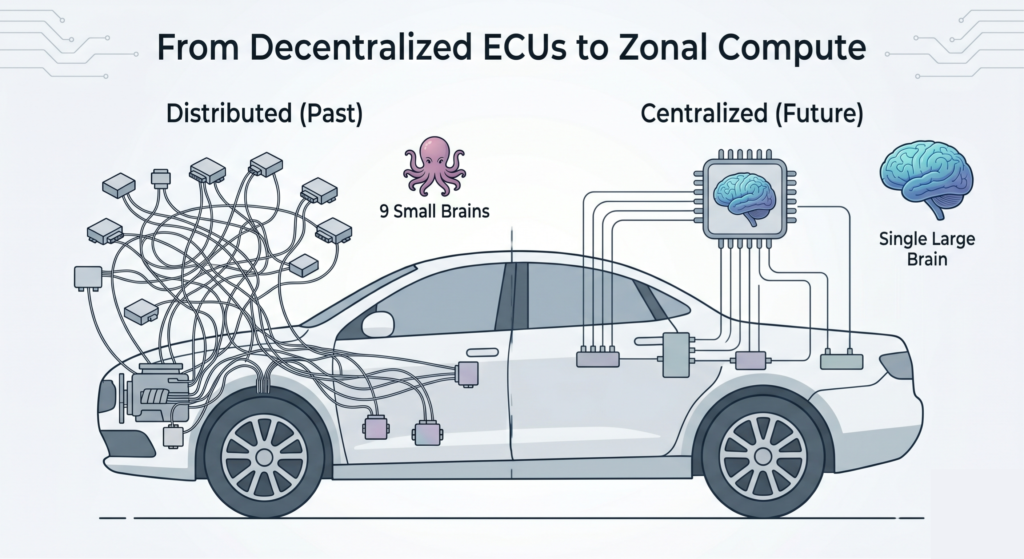
Moesle opened his talk with a fascinating biological analogy: while some marine life relies on decentralized, siloed nervous systems (like an octopus with 9 brains), nature’s most flexible and powerful machine—the human being—relies on a single, centralized brain.
The automotive industry is going through the exact same evolutionary transition:
- Past (Distributed): Independent Electronic Control Units (ECUs) scattered across the vehicle, leading to a massive maze of wiring and making software updates incredibly difficult.
- Today (Domain): Functions are isolated into specific silos (e.g., Infotainment, ADAS), which unfortunately introduces data exchange bottlenecks and limited scalability.
- Future (Zonal & Central Compute): A shift toward a highly centralized architecture featuring a unified “Superbrain” domain controller connected to zonal aggregators. This approach promises up to a 50% reduction in weight and hardware costs while enabling seamless compute-sharing across functions.
With the exponential hunger for compute driven by massive in-vehicle infotainment (IVI) displays, AI agents, and automated driving sensor suites (such as systems utilizing up to 12 cameras, 5 radars, and 3 LiDARs), the modern vehicle is no longer just a car—it is a literal “Data Center on Wheels.”
The Triple Edge Dilemma: Power, Heat, and Cost
Moving a data center into a moving vehicle introduces brutal engineering constraints. Moesle highlighted the triple challenges that automotive architects face when centralizing compute:
- Power Consumption: Running massive autonomous driving and IVI workloads drains battery range.
- Thermal Management: Packaging high-density silicon into tight vehicle spaces creates severe heat dissipation bottlenecks.
- Cost Pressure: Monolithic processors face low production yields on advanced nodes, making scaling financially unsustainable.
To solve the cost and scaling crisis of monolithic chips, the industry is aggressively moving toward Open, Heterogeneous Chiplet Architectures supported by global standards like UCIe and ASRA. By breaking down a massive processor into smaller, specialized chiplets, manufacturers can optimize for yield, scale efficiently, and mix-and-match specialized silicon.
Bridging the Heterogeneous Gap: The Fixstars Perspective
This is exactly where the presentation transitioned from hardware architecture to a critical software challenge—and where Fixstars sits at the center of the ecosystem.
Centralizing compute onto a heterogeneous chiplet architecture means the vehicle’s software stack becomes multi-layered and highly complex. As Moesle illustrated, the layered software stack requires co-creation across:
- Layered Software Stacks: Integrating parking, driving assistance, infotainment, and autonomous driving.
- Middleware & RTOS: Orchestrating real-time operating systems (like QNX or Wind River) alongside infotainment platforms (Linux/Android) under unified hypervisors.
- Open Source Collaboration: Initiatives like S-CORE (Open Source Automotive Middleware) are emerging to standardize the foundational layers so the industry can avoid vendor lock-in.
Why Software Optimization is the Real Enabler
You can design the perfect open chiplet architecture, but if the software stack cannot efficiently map workloads across those heterogeneous cores, you will trigger the exact power and thermal failures Valeo warned about.
At Fixstars, our expertise is built for this exact inflection point. We specialize in hardware-aware software optimization. When a vehicle’s architecture consolidates into a single, heterogeneous “Superbrain,” our role is to optimize the middleware, real-time operating systems, and AI models down to the metal.
By utilizing advanced parallel computing techniques and maximizing the throughput of specialized accelerators, we minimize latency while drastically reducing power consumption and thermal load. In short, we help prevent the “Data Center on Wheels” from overheating and draining the vehicle’s battery.
Moving Forward Together
The session concluded with a powerful takeaway: the transition to a centralized, future-proof Software-Defined Vehicle (SDV) cannot be achieved alone. It requires massive industry collaboration, open source thinking, and specialized partnerships.
As the automotive stack standardizes around open middleware and chiplet ecosystems, the ultimate differentiator will be execution speed and software efficiency. Fixstars is incredibly proud to be part of the community accelerating this transition, ensuring that tomorrow’s centralized vehicle architectures are fast, safe, and highly optimized.
Discover how Fixstars accelerates automotive software and edge AI optimization here.
Given how quickly vehicle architectures are consolidating into a unified “Superbrain,” are you currently seeing the power, thermal, or latency constraints of heterogeneous hardware affect your own software deployment pipelines?
Author
