I recently had the opportunity to attend the Embedded Vision Summit, where one session in particular truly resonated with me. Dr. Andy Xiao, Staff AI Systems Engineer at Rivian and Volkswagen Group Technologies, delivered a compelling presentation titled “The Rise of the AI-Defined Enterprise: From Autonomous Vehicles to Robots and the Future of Intelligent Machines.”
Listening to his insights on how physical AI is evolving, I found myself nodding along—especially when the discussion turned to the brutal reality of deploying these massive models to the edge. Here are my key takeaways from the session, and my thoughts on how the industry must overcome its next big hurdle.
Key takeaways
- Autonomous vehicles are moving from modular, hand-designed stacks to unified AI stacks built on foundation models, and makers of humanoid robots and industrial automation are following the same approach.
- How fast a company can run its data flywheel (collect, curate, train, deploy) is becoming its main competitive edge, with models updated continuously over the air.
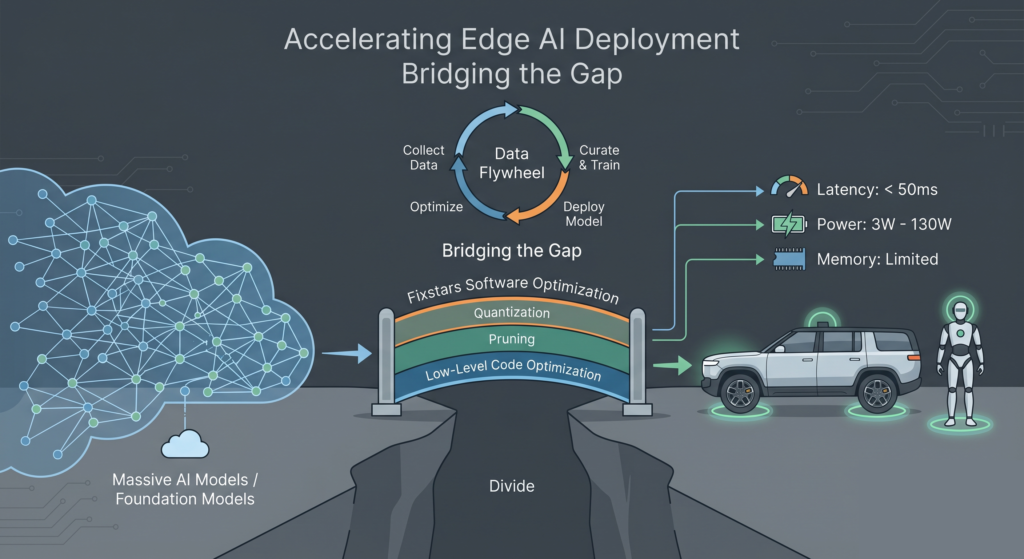
- Edge deployment is the bottleneck: a 50 ms inference budget (a car at 70 mph covers 1.5 m in that time), 3 to 130 W power budgets, and the need to prune, quantize, and cross-compile for different hardware across the fleet.
The Paradigm Shift: From “Software-Defined” to “AI-Defined”
The core thesis of Dr. Xiao’s talk was that we are officially moving past the “Software-Defined” era into the “AI-Defined” era.
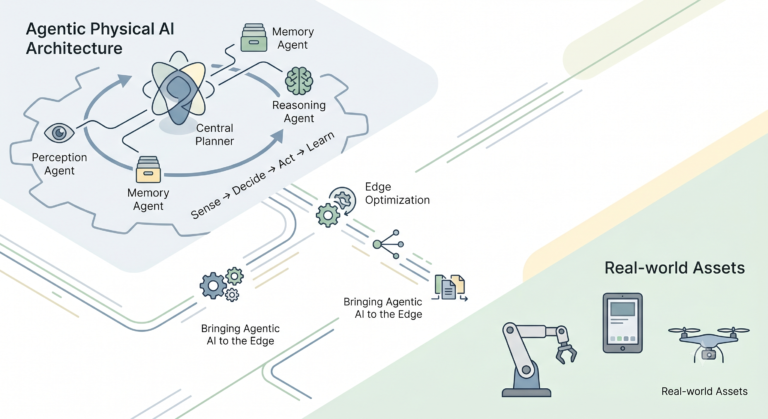
Historically, complex systems like autonomous vehicles (AVs) relied on modular stacks with hand-designed interfaces—separate modules for perception, localization, prediction, and planning. Today, that siloed architecture is being replaced by a Unified AI Stack. We are seeing a shift toward end-to-end learned behavior driven by foundation models.
What’s fascinating is the convergence of Physical AI. The architectural patterns pioneered by autonomous vehicles are now being adopted directly by makers of humanoid robots and industrial automation systems. The playbook has been written; now, it’s being applied across all physical domains.
The New Competitive Moat: The Data Flywheel
If the AI-defined architecture is the engine, the Data Flywheel is the fuel. Dr. Xiao emphasized that in this new era, the speed at which a company can spin its data flywheel (Collect ➔ Curate ➔ Train ➔ Deploy) is its ultimate competitive advantage.
Updates are no longer discrete release cycles; they are continuous, over-the-air (OTA) improvements. The faster you can push improved models to the edge and measure performance against real-world data, the further you pull ahead of the competition.
The Bottleneck: Edge Deployment Challenges (A Fixstars Perspective)
While the vision of unified foundation models running the physical world is exciting, Dr. Xiao dedicated a critical portion of his presentation to “Deployment Pipelines for the Edge.” This is exactly where the theory meets reality—and where my ears really perked up, as this is the exact challenge we tackle every day at Fixstars.
Dr. Xiao highlighted the severe constraints of Edge Deployment:
- Latency: A 50ms inference budget (a vehicle traveling at 70 mph moves 1.5 meters in that time).
- Power: A strict 3–130W power budget in production edge platforms.
- Model Size: The absolute necessity for pruning and quantization without losing accuracy.
- Fleet Diversity: Deploying the same model across different hardware architectures requiring cross-compilation at scale.
You can have the most advanced foundation model in the cloud, but if it cannot run within a 50ms latency window on a low-power edge device, it cannot be safely shipped in an autonomous vehicle or a humanoid robot.
Bridging the Gap with Software Optimization
This session reinforced my belief that software acceleration and hardware-aware optimization are no longer optional—they are the critical enablers of the AI-Defined era.
At Fixstars, we see this exact pain point across our client base. As AI models grow exponentially larger, the edge hardware (CPUs, GPUs, NPUs) struggles to keep up. To maintain the “Speed of the Flywheel” that Dr. Xiao mentioned, companies need highly optimized deployment pipelines.
Whether it is applying advanced quantization techniques, optimizing memory access, or writing low-level code tailored to specific edge architectures, bridging the gap between massive AI models and constrained physical hardware is what Fixstars does best.
The transition to AI-defined machines is inevitable. By 2030, as Dr. Xiao predicted, AI leads will drive organizational strategy. The companies that will win are the ones that can not only train the smartest models but also execute them the fastest and most efficiently in the real world.
Learn more about how Fixstars accelerates AI deployment and edge computing at https://www.fixstars.com/en
Related reading: Event Report: Designing the “Data Center on Wheels” — Insights from Valeo at the 2026 Embedded Vision Summit and Measuring What Actually Matters in Real-Time ADAS Perception
Moving AI onto embedded or edge hardware?
Fixstars engineers port and optimize AI models and embedded software for your target chips, including NVIDIA Jetson and DRIVE, Renesas R-Car, and Qualcomm Snapdragon.
Request a free assessmentAuthor

Miho Yoneda
Marketing Lead at Fixstars Solutions