TL;DR: Two legal talks at Autonomous Vehicles & AI USA 2026 covered gaps engineering teams end up living with. Former NHTSA chief counsel Adam Raviv explained why the US still has no federal safety standard for automated driving systems and proposed a three-stage path to one. Carlton D. Wilde III of Bracewell showed how a single AV cyber incident can be excluded under auto, cyber and general liability insurance at the same time.
Not every useful session at Autonomous Vehicles & AI USA 2026 (Anaheim, August 26–27) was about sensors or software. Two talks given by lawyers covered questions engineering teams rarely discuss but end up living with: what federal rules actually require for AV safety, and what happens when something goes wrong and the insurance doesn’t pay.
Adam Raviv, former chief counsel at NHTSA and now global co-chair of Sidley Austin’s automotive and mobility practice, spoke on national regulation. Carlton D. Wilde III, a partner at Bracewell, spoke on insurance coverage gaps facing AV companies.
This post summarizes the two talks and is not legal advice.
Key takeaways
- Federal Motor Vehicle Safety Standards (FMVSS) cover vehicle hardware, but there is still no federal standard for the automated driving system itself.
- Statistically showing that an AV matches the human fatal-crash rate would take roughly 275 million test miles at 95% confidence. For comparison, Raviv noted that Waymo has driven about 100 million.
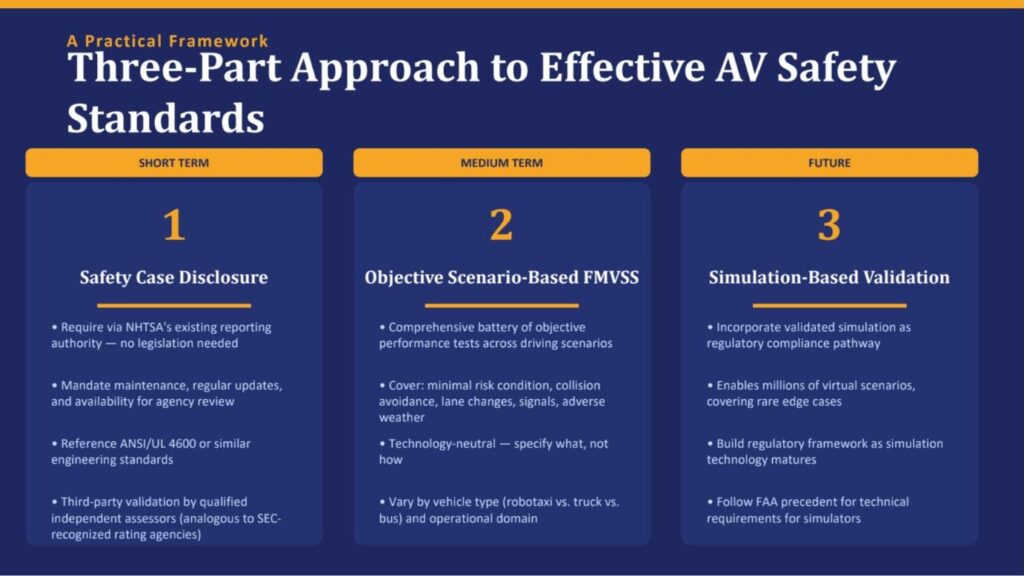
- Raviv proposed a three-stage path: safety case disclosure now, objective scenario-based standards next, and validated simulation later.
- Wilde showed how one incident, an OTA exploit that leads to a crash, can be excluded under auto, cyber and general liability policies at the same time.
- For engineering teams, both talks point to the same need: objective test criteria and well-preserved evidence.
Where US regulation stands
Raviv’s talk drew on his article “Rules of the Road: Toward National Regulation of Autonomous Vehicles,” published in the 2026 Journal of Law and Mobility (University of Michigan Law School). His starting point was that FMVSS apply to AVs the same way they apply to human-driven vehicles. They cover braking, airbags, seatbelts and other equipment, and they don’t require a human driver. What’s missing is a federal performance requirement for the system that does the driving, consistency across the 50 states, premarket validation specific to autonomy, and an objective threshold for what counts as “safe enough.”
Under the current system, manufacturers certify their own compliance with FMVSS, and NHTSA doesn’t approve vehicles in advance. Its other main tool is recall authority for defects that pose an unreasonable safety risk, which only works after the fact. He counted 13 AV recalls from four companies between 2022 and 2025.
AV companies have two federal routes today. They can comply with every existing FMVSS, which keeps the design close to a conventional car. Or they can apply for an exemption by showing an equivalent overall level of safety. That allows designs without a steering wheel, but the process is slow, capped at 2,500 vehicles a year, and has been granted only twice for AVs.
There has been plenty of activity in Washington without an ADS safety standard coming out of it. NHTSA has required AV crash reporting under its Standing General Order since 2021. The AV STEP proposal from January 2025 was withdrawn in June 2026. A SELF DRIVE Act draft circulated in January 2026 is still pending, and the July 2026 DOT regulatory agenda includes planned rulemaking on ADS behavioral competencies.
Outside the US, he described the EU framework as the most developed but still dependent on qualitative terms like “adequate.” China is deploying most aggressively, with regulation largely at the municipal level. Japan uses a permit-based process for Level 4 that focuses on route planning and remote monitoring. And UN WP.29 adopted its first Global Technical Regulation on ADS in June 2026, though it intentionally doesn’t set specific objective performance criteria.
Why it’s hard
- Complexity: automatic emergency braking does one thing. An ADS has to do everything a human driver does across an endless range of scenarios.
- Rarity of serious crashes: there is about one fatal crash per 79 million miles driven, which is why matching that rate with 95% confidence requires around 275 million test miles.
- Objectivity: US law requires every FMVSS to be stated in objective, repeatable terms. Words like “adequate” or “reasonable” don’t hold up legally.
A proposed path
- Short term: require companies to disclose and maintain a safety case under NHTSA’s existing reporting authority, referencing ANSI/UL 4600 or a similar standard, with review by qualified independent assessors.
- Medium term: a set of objective, technology-neutral performance tests across driving scenarios, including minimal risk conditions, collision avoidance, lane changes, signals and adverse weather, varying by vehicle type and operating domain.
- Future: accept validated simulation as a compliance route, following the FAA’s precedent for simulator requirements.
He also listed what makes a standard worse than none at all: tied too closely to today’s technology, written for one type of vehicle, too vague to mean anything, lacking full federal preemption, or relying on non-objective language.
When a hack causes a crash: the insurance gap
Wilde represents policyholders, not insurers, in coverage disputes. His argument was that the usual mix of auto liability, cyber and commercial general liability (CGL) policies leaves a gap exactly where AV companies are most exposed.
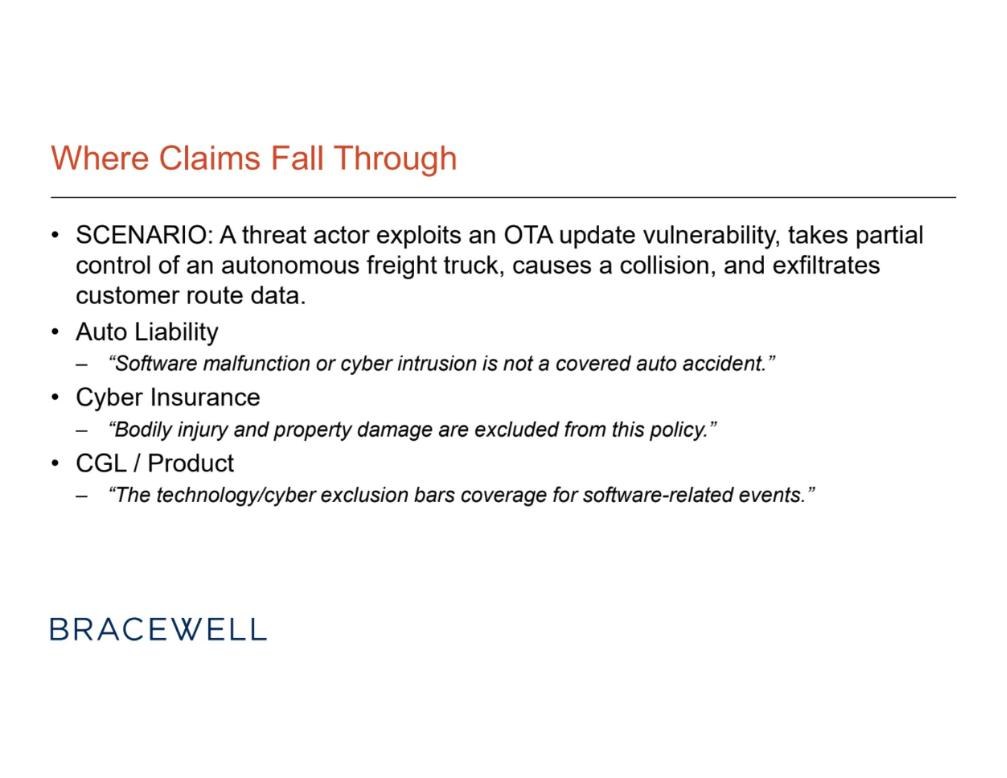
His example: an attacker exploits a vulnerability in an OTA update, takes partial control of an autonomous truck, causes a collision and steals customer route data. The auto policy may treat a software malfunction or cyber intrusion as outside a covered accident. The cyber policy may exclude bodily injury and property damage. The CGL policy may have a technology exclusion for software-related events. Each policy can point to one of the others.
He described four main attack paths for connected vehicles: OTA update channels, tampered sensor and telematics data feeding AI decisions, V2X links, and backdoors in hardware or firmware introduced through the supply chain.
He then went through how insurers deny these claims. Besides exclusions, they look for missing security controls such as inconsistent MFA, unpatched systems, outdated incident response plans and loosely managed vendor access. They argue late notice, which is a bigger problem for AVs because a compromised system may run on public roads for weeks before anyone notices. And when an attack is linked to a state actor, they may invoke war or hostile-act exclusions. He added that new regulations, such as the BIS connected-vehicle rule and UNECE WP.29 cybersecurity and software update requirements, often find their way into policy language as warranties, which insurers can later cite as grounds for denial.
His advice included negotiating AV-specific endorsements, having coverage counsel review every exclusion, making sure at least one policy clearly covers a cyber event that causes physical harm, keeping actual security controls consistent with what was stated on the underwriting application, and preparing a 72-hour incident protocol. In the first few hours, that means preserving vehicle logs, sensor data, software versions, OTA records and network traffic before they’re overwritten.
The Fixstars perspective
Neither talk was about engineering, but both lead to engineering requirements.
If regulation moves toward objective, technology-neutral, scenario-based standards, as Raviv proposed, AV systems will increasingly be judged by measurable behavior in defined scenarios. Test setups that reproduce results exactly, and models that behave consistently across hardware targets and toolchain versions, become more important.
Wilde’s talk is a reminder that logs, software versions and OTA records are evidence, and they only help if they’re complete, trustworthy and preserved. That ties directly to Dr. Mohamed El-Hadedy’s talk on tamper-evident runtime records at the same event. Configuration management, reproducible builds and documented security controls are often treated as overhead, but they’re also what a company relies on when a regulator, insurer or court asks what happened.
Conclusion
The regulatory picture for AVs in the US is still unsettled, and insurance hasn’t caught up. For engineering teams, the useful response is the same either way: build systems whose behavior can be tested objectively, and keep the evidence.
FAQ
According to Adam Raviv, former chief counsel at NHTSA, there is not. Federal Motor Vehicle Safety Standards (FMVSS) cover vehicle equipment such as brakes, airbags and seatbelts, but as of his August 2026 talk there was no federal performance standard for the automated driving system itself.
Carlton D. Wilde III of Bracewell explained that auto policies may exclude software malfunctions and cyber intrusions, cyber policies may exclude bodily injury and property damage, and general liability policies may exclude technology-related events. A single incident can fall between all three.
Raviv cited roughly one fatal crash per 79 million miles driven in the US, which means about 275 million test miles to show an equivalent rate with 95% confidence.
Wilde recommended preserving vehicle logs, sensor data, software versions, OTA records and network traffic in the first few hours, before the data is overwritten.
Raviv’s full article is available in the University of Michigan Law School repository (repository.law.umich.edu/jlm/vol2026/iss1/7).
Moving AI onto embedded or edge hardware?
Fixstars engineers port and optimize AI models and embedded software for your target chips, including NVIDIA Jetson and DRIVE, Renesas R-Car, and Qualcomm Snapdragon.
Request a free assessmentAuthor

Miho Yoneda
Marketing Lead at Fixstars Solutions