TL;DR: Fixstars exhibited at Autonomous Vehicles & AI USA 2026 in Anaheim on August 26–27, and our CTO Takuro Iizuka spoke on AI-augmented embedded development for SDVs. Other sessions we found useful covered runtime AV safety, measurable software assurance, sensing and HD maps, regulation and insurance, and the economics of scaling autonomous fleets. Three of them have their own detailed reports, linked below.
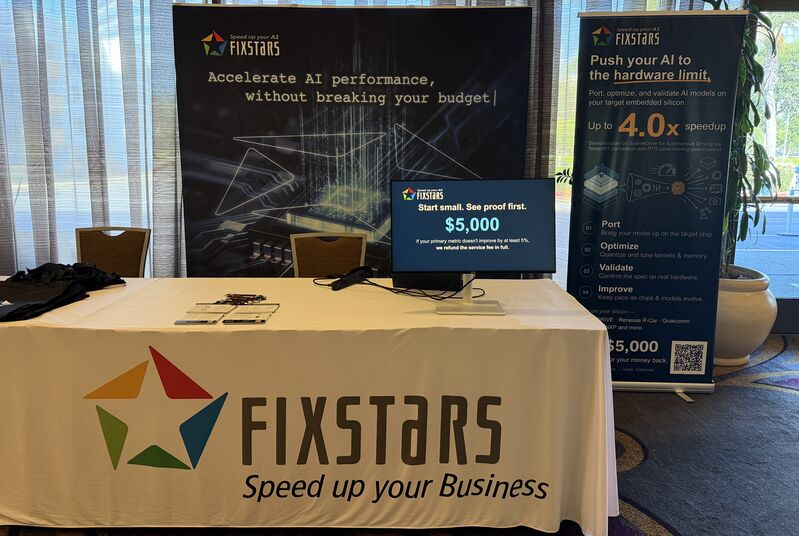
On August 26–27, Fixstars exhibited at Autonomous Vehicles & AI USA 2026 at Hotel FERA in Anaheim, California. It’s a compact event compared with the big auto shows, which made it easy to have longer conversations with engineers, startups, researchers and even lawyers working on autonomous systems.
Our talk: AI-augmented embedded development
On Day 2, Fixstars CTO Takuro Iizuka presented “AI-Augmented Embedded Development: The Missing Link in SDV Delivery.” He walked through two SDV projects where Fixstars engineers worked with AI agents on real performance engineering: a 10,000-line rewrite that made an autonomous driving model train 1.7x faster, and a SparseDrive deployment on NVIDIA DRIVE AGX Thor that went from 162.3 ms to 41 ms per iteration in about one person-week. He also laid out what is still missing before AI fits into automotive development processes. Read our write-up of the talk →
Below are the other sessions we found most useful, grouped by theme. Three of them have their own detailed write-ups.
Runtime safety and measurable assurance
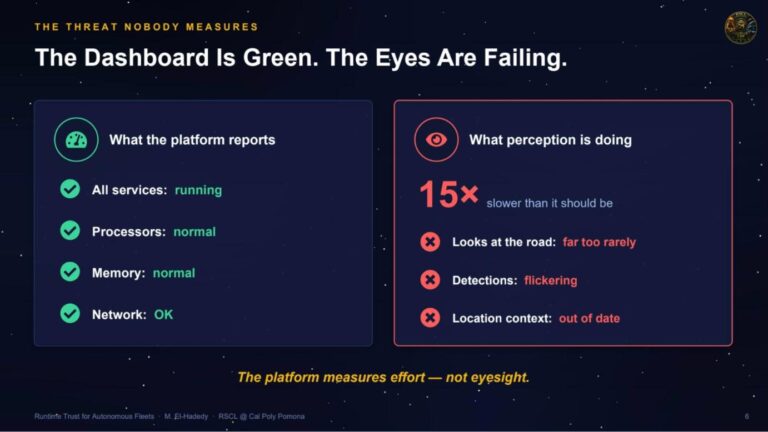
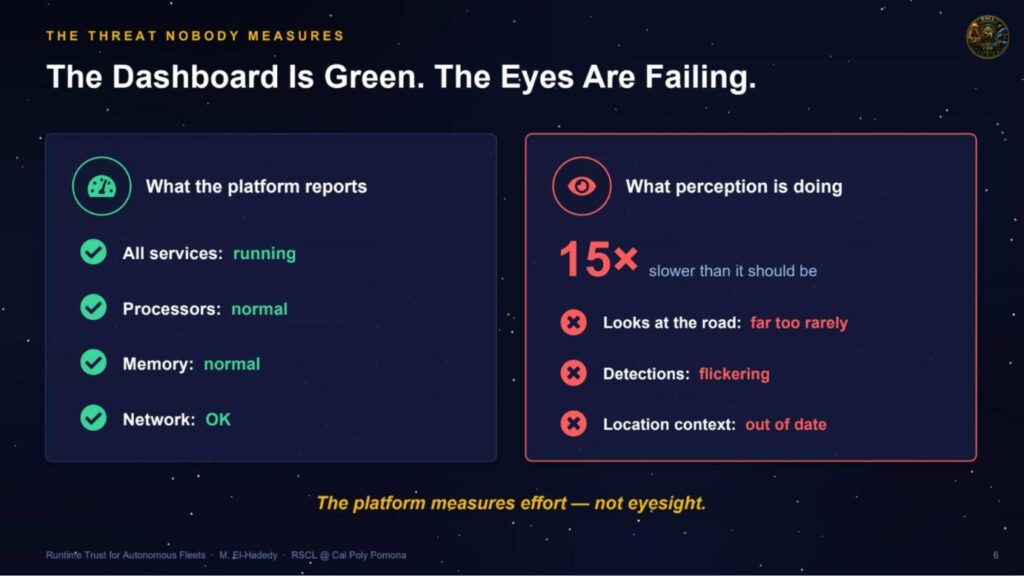
Dr. Mohamed El-Hadedy (Cal Poly Pomona / UIUC) showed how perception on a shared in-vehicle computer can slow down about 15x while every platform health metric still looks normal. His group’s answer is a “perception integrity contract” that checks frame rate, output stability and context freshness every five seconds, feeds failures back into scheduling, and records each verdict in a tamper-evident chain. On edge hardware, it kept perception at 27–30 frames per second under stress. Read our full report →
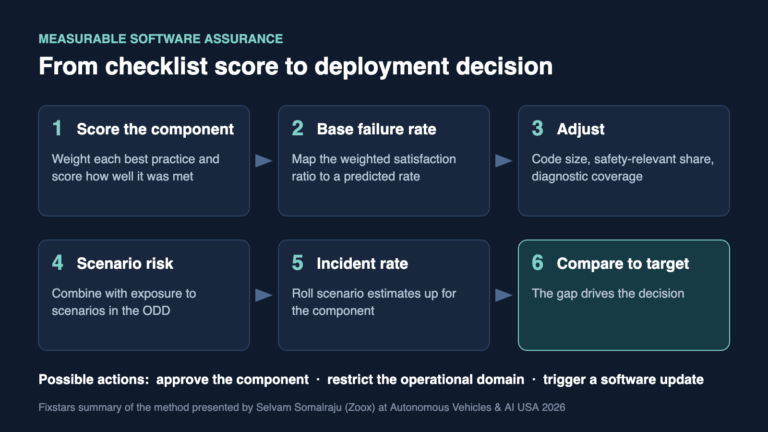
Selvam Somalraju (Zoox) looked at the gap between following safety standards and knowing how much safer the software actually is. He outlined a four-pillar assurance framework and a method that turns weighted best-practice scores into estimated failure rates, ODD-specific risk and, ultimately, deployment decisions. Read our full report →
Sensing and maps
Dr. Gunnar Juergens (Teradar) presented terahertz sensing as a middle ground between radar and lidar, aiming for lidar-like resolution with radar-like robustness in fog, rain, snow and glare, where cameras and lidar tend to struggle.
[EDITOR NOTE: Teradar’s slides were marked “Confidential.” Keep this paragraph at the level of what was said publicly, or confirm with Teradar before publishing.]
John Ford (Vexcel) explained how aerial imagery feeds HD maps. Onboard sensors perceive the world in real time, and HD maps are the reference they check against. Vexcel says it refreshes imagery covering about 90% of the US population every year, and major metro areas up to three times a year. The same data is increasingly used for AI-based feature extraction and as the basis for simulation and synthetic training data.
Mettis AI made the case for a “human intent layer”: real-world driver behavior data, collected through commercial deployments such as driving schools, fleets and ride hailing in Europe and Latin America, to help AVs drive in a more natural, human-like way.
Regulation and liability
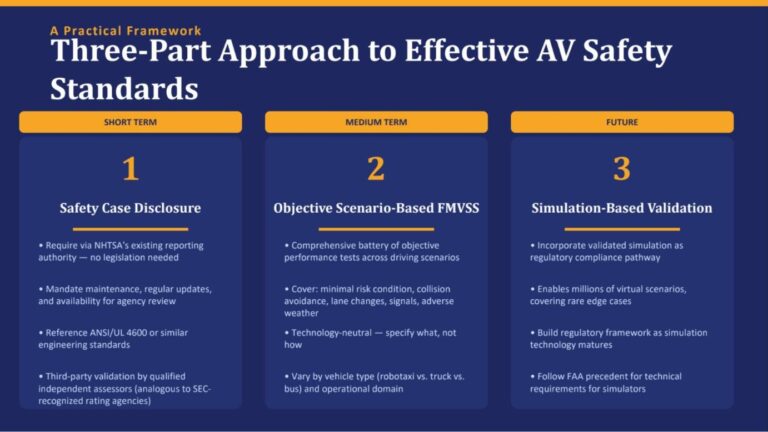
Adam Raviv (Sidley Austin, former NHTSA chief counsel) explained why there is still no federal safety standard for the automated driving system itself, and proposed a path from safety case disclosure to objective scenario-based standards to validated simulation. Carlton D. Wilde III (Bracewell) showed how auto, cyber and general liability policies can each exclude the same AV cyber incident, and what companies can do about it. Read our full report →
The business of scaling
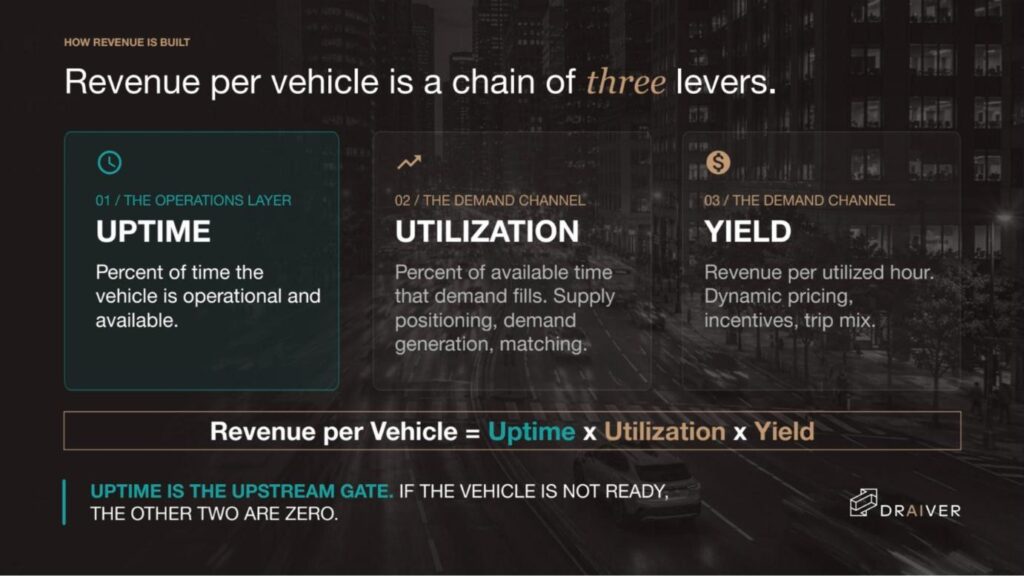
Fede Ranero (Draiver) argued that autonomy scales when the economics work. Technology costs are falling with thousands of engineers working on them, but revenue per vehicle is still an open question. He broke it into uptime × utilization × yield, with uptime as the first gate: if the vehicle isn’t ready to operate, the other two don’t matter. His company focuses on that physical operations layer.
Blair Schlecter (Beverly Hills Chamber of Commerce) discussed what robotaxis and shared AV services could mean for car ownership. For consumers, the possible upside includes several thousand dollars a year in savings on insurance, registration and maintenance, plus freed-up garage space and time. The trade-offs include range limits, less freedom of movement and the cost of shared rides. For cities and businesses, the effects reach insurance, parking, curb management and jobs.
ATRI Group introduced its work on autonomous rapid transit pods, bus electrification and other clean mobility infrastructure that it builds, finances and operates.
What we took away
One thread ran through many of the sessions: the conversation is shifting from whether autonomy works to how to prove, continuously and objectively, that it is working, and who is responsible when it isn’t.
For a company focused on making AI run efficiently on embedded and edge hardware, that shift matters. Compute headroom, consistent behavior across toolchains, and optimization work that can be traced and verified are becoming part of the safety argument, not just a performance concern.
FAQ
It was held on August 26–27, 2026, at Hotel FERA in Anaheim, California.
Sessions covered runtime safety and measurable software assurance for AV software, sensing and HD maps, US regulation and insurance for autonomous vehicles, and the economics of scaling autonomous fleets.
Speakers covered in this report came from Zoox, Cal Poly Pomona and the University of Illinois, Teradar, Vexcel, Mettis AI, Sidley Austin, Bracewell, Draiver, ATRI Group and the Beverly Hills Chamber of Commerce.
Yes. Fixstars exhibited at the event, and Fixstars CTO Takuro Iizuka gave a talk titled “AI-Augmented Embedded Development: The Missing Link in SDV Delivery,” covering two SDV projects where AI agents did performance engineering work.
Thank you to everyone who stopped by our booth. If you’re working on deploying AI models to in-vehicle or edge platforms, learn more about our AI Model Porting & Optimization service and Fixstars Vega.
Moving AI onto embedded or edge hardware?
Fixstars engineers port and optimize AI models and embedded software for your target chips, including NVIDIA Jetson and DRIVE, Renesas R-Car, and Qualcomm Snapdragon.
Request a free assessmentAuthor
Miho Yoneda
Marketing Lead at Fixstars Solutions